
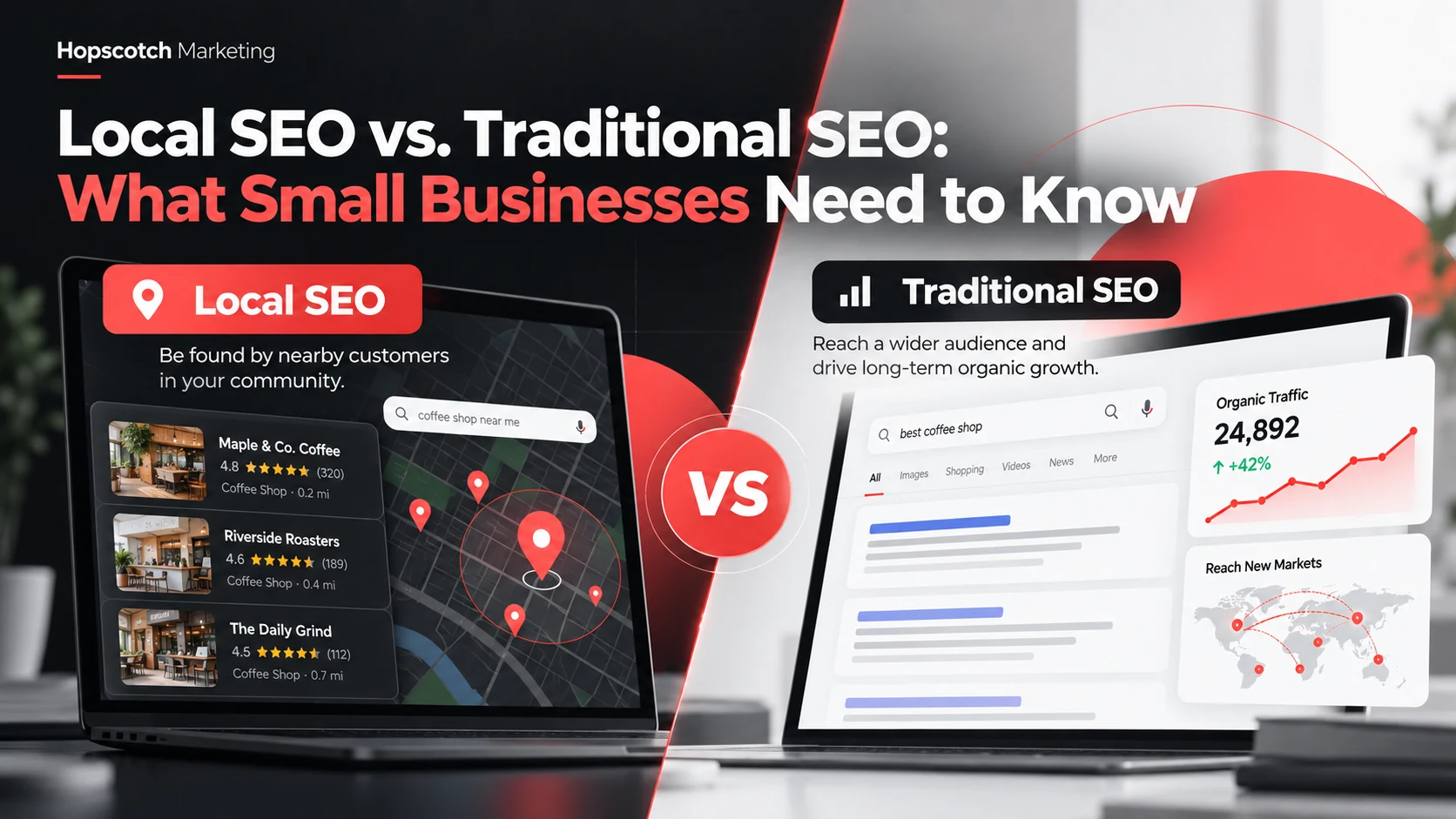
When business owners hear “SEO,” they often imagine one set of tactics that should help every company appear higher in Google. In practice, a neighborhood plumber, a regional law firm, and an online software provider can have very different search needs.
Two useful terms are local SEO and traditional SEO, sometimes called broader organic SEO. They overlap, but they answer different customer questions. Understanding the distinction can help you spend effort where your prospective customers actually look.
What is local SEO?
Local SEO focuses on helping people discover a relevant business in a particular geographic market. A search such as “roof repair near me” or “HVAC service in Orange County” may include a map and business listings alongside standard website results.
Local SEO usually involves a well-maintained Google Business Profile when eligible, accurate contact and service-area information, location-relevant website content, consistent business information across important listings, and a trustworthy local reputation.
For a business that serves people at a physical location or travels to customers, these are often essential discovery paths. A local presence is not just about adding city names to every page; it is about showing that you offer a specific service in a real market.
What is traditional SEO?
Traditional SEO generally refers to improving how website pages appear in organic search results beyond a specific local map listing. The work may include technical website health, useful service content, internal linking, clear page titles, well-organized information, and earning references from reputable websites.
A company publishing educational resources for a regional or national audience may depend on broader organic searches even when local map rankings are not relevant. A local business can also benefit from traditional SEO: its service pages and practical articles may appear in organic results below or alongside the map.
The main differences at a glance
- Search intent: Local SEO often serves people looking for a nearby provider; broader SEO may serve research, comparisons, and purchases at any geographic scale.
- Where customers see results: Local SEO includes Maps and business profiles; broader SEO emphasizes individual website pages in organic results.
- Important assets: Local efforts rely heavily on accurate profiles, location and service information, and reviews; broader efforts emphasize website architecture and high-quality content.
- Measurement: Local teams may track calls, directions, and local inquiries; broader teams may track qualified organic leads, signups, and relevant page-level engagement.
Both approaches depend on the same fundamentals
A clear website, accurate information, a helpful user experience, and honest descriptions of your services benefit both. Neither approach should rely on large numbers of nearly identical pages with city names swapped into the copy. Pages work best when they provide specific value to the intended reader.
The distinction isn’t that local SEO is easy and traditional SEO is hard. Competition, customer behavior, service areas, site quality, and your business model all influence the work required.
How Google evaluates local results
Google explains that local rankings are mainly based on relevance, distance, and prominence. You can improve clarity and completeness, but you cannot pay Google to secure a better local organic ranking or guarantee one particular map position. For details, review Google’s local ranking guidance.
For standard organic website results, useful page content and a technically accessible site remain important. A profile and a website can reinforce each other: the profile helps customers find and contact the business, while service pages explain the offer in depth.
Which should your business prioritize?
Start with how you actually win customers. If you are a home-service contractor, local search visibility and accurate service-area information will likely be central. If you sell specialized B2B services across the country, broader educational and service-related organic search may be more important. If you do both, you need a coordinated approach.
- Local service business: Verify profile accuracy, build clear service pages, and measure qualified calls and inquiries.
- Multi-location operation: Give each legitimate location useful, specific information and maintain its corresponding business details.
- Regional or national B2B provider: Develop substantive service and educational pages for the problems prospective buyers research.
- Hybrid business: Connect location visibility, service pages, articles, and lead tracking into one reporting framework.
A sensible way to start
List your highest-value services, the geographic markets you truly cover, and the questions a buyer asks before making contact. Then review what already performs well and which pages or profile details leave important questions unanswered.
You don’t need to choose between maps and website results as if only one can matter. You need a plan that matches your customers. Explore Hopscotch’s local SEO services and broader SEO management, or talk with our team about the right mix.